Innovation Spotlight~ Automated External Defibrillator Location Display Experience
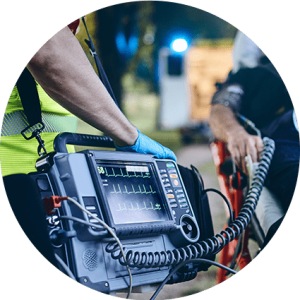
GeoComm partnered with Stearns County, Minnesota, and a local non-profit in 2019 on an initiative aimed at mapping the location information for Automatic Emergency Defibrillators (AEDs) in Stearns County. The goal of the project was to empower 9-1-1 PSAPs with AED location information so PSAP call takers could inform 9-1-1 callers of nearby AED locations. The effort made the AED locations readily available to telecommunicators; a learning that is actively being worked on to implement representing AED icons differently between those that are accessible 24/7/365, such as outside of a building, and those that are behind closed access or within buildings with certain office hours.
Through research performed by the local non-profit, it was observed that while many AEDs exist, often no one knows where they are located. In turn, the non-profit created an AED inventory for Stearns County and requested GeoComm add this information as a map layer to GeoComm Dispatch Map being used in the Stearns County 9-1-1 PSAP. To accomplish this, GeoComm staff worked with the non-profit to align their inventory to existing features in GeoComm Dispatch Map that could support AEDs, GeoCoded and QC’d the point locations to ensure accuracy, and deployed the map updates to the Stearns system to make the AED locations accessible to the Stearns County first responders.
The project supports a long-term initiative of GeoComm’s by reviewing one of the many kinds of additional map data content that has the potential to be highly valuable and actionable to 9-1-1 PSAP call takers. In early 2020 the project was profiled on KARE 11, the Minneapolis/St. Paul NBC affiliate.