Texas

Secure Funding for Critical Incident Mapping

Under the TEA SAFE Cycle 1 and Cycle 2 Grants

Learn how GeoComm streamlines your application and maximizes your grant for critical incident mapping in partnership with the Texas Education Agency (TEA).
Navigate funding with Larry Warner your Regional Expert
By completing and submitting the form, I acknowledge GeoComm’s Privacy Policy.
TEA SAFE Cycle 1 and Cycle 2 Grants Guide

Download the Guide to Optimize Your SAFE Grant Funding

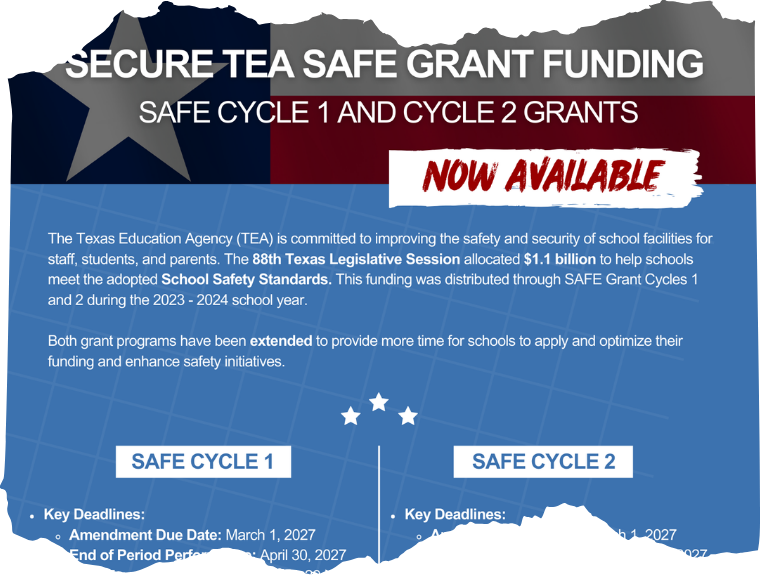
  • Amendment Due Date March 1, 2027
  • End of Period Performance April 30, 2027
  • Final Expenditure Report Due July 29, 2027
TEA SAFE Article

GeoComm Meets All Grant Requirements for the SAFE Cycle 1 and Cycle 2 Grants. Including TX House Bill 3

Helping first responders access precise data to improve response times. Our school mapping solutions meet all program criteria:
  • Accurate Critical Incident Mapping be an accurate map of each district campus and school building that is developed and documented in accordance with the standards described by Section 37.351 related to developing site and floor plans, access control, and exterior door numbering
  • Walk-Through Verification provide an opportunity to conduct a walk-through of each district campus and school building using the map
wrapper-deco-left-raw
wrapper-deco-right-raw
school safety and critical incident mapping for schools
44.5 M+

Total Square Footage

Mapped in Texas

school safety and critical incident mapping for schools
60

Implementation

Avg. Map Implementation Turnaround Time (30 Buildings or Fewer)

school safety and critical incident mapping for schools
2190 +

Hours Saved

Avg. Maintenance Time Saved by switching from Static PDFs to Responsive Digital Representations

  • “The addition of indoor maps integrated with our 9-1-1 software supports emergency personnel identification of specific room locations of 9-1-1 callers.” Greg Ballentine, Executive Director – Denco Area 9-1-1 District
Greg Ballentine Denco

Enhance School Safety with Critical Incident Mapping

Leverage critical incident maps to improve emergency response and protect your school community
  • Reduce Manual Effort Save time and resources with dynamic maps
  • Collaborate at all levels Facilitate easier collaboration between all agencies
  • Personalize your maps Clearer, smarter visuals with custom school layouts

Ready to Apply for Your School Safety Funding?

Get expert help to align spending, tailor solutions, and ensure TEA compliance for a safer school environment.

Share and Communicate with Agencies

Enhance communication through seamless integration with critical incident mapping across our partner network. From emergency response tools to top public safety solutions, we streamline data sharing for faster, more effective responses.
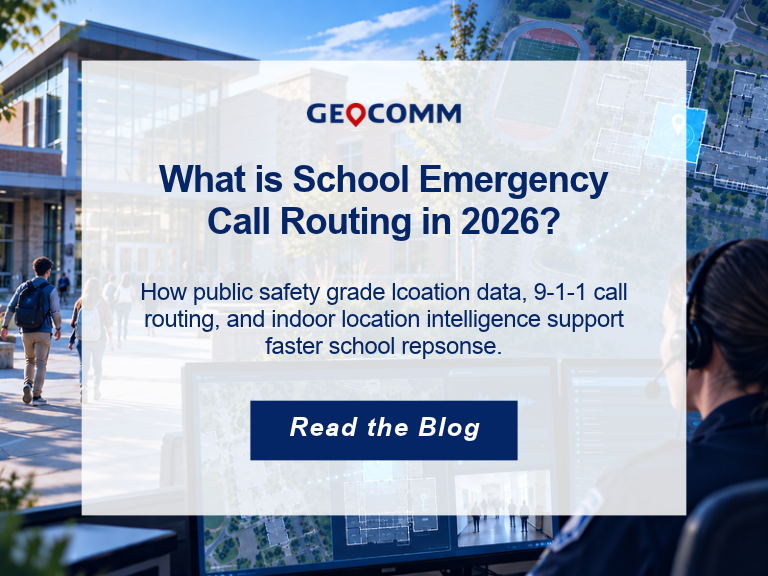
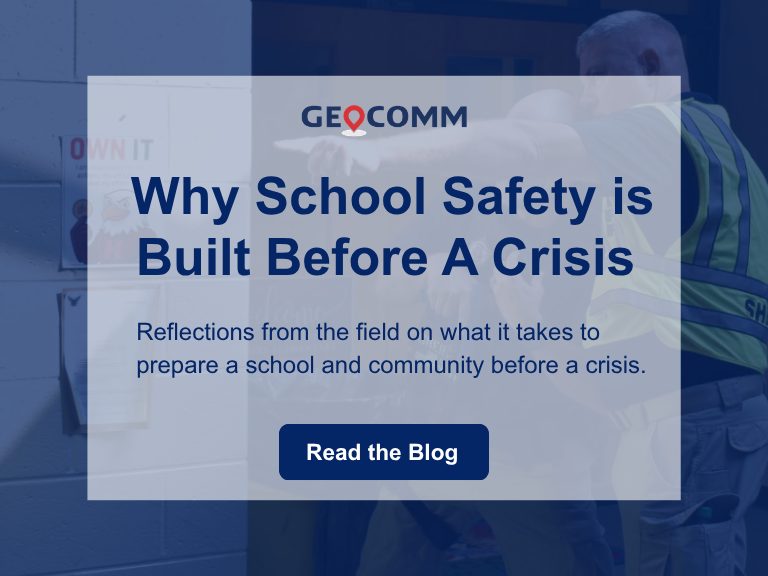
School Safety Resources

AI Needs GIS

By John Brosowsky, SVP of Innovation, GeoComm Artificial intelligence is rapidly reshaping PSAP operations. From handling non-emergency calls to enabling real-time 9-1-1 transcription, translation, keyword detection, and call taker assistance, AI is becoming an integral part of modern emergency communications. But AI is not inherently intelligent; it identifies patterns and relationships within the information it has been trained on…

GeoComm and geoConvergence Announce Partnership to Support the Future of Indoor Mapping

Partnership highlights the increasing role of accurate indoor maps, GIS data, and public safety grade location intelligence in emergency response, school safety, and facility operations. ST. CLOUD, Minn., July 10, 2026 /PRNewswire/ — GeoComm, the nation’s leader in public safety grade location intelligence, today announced a new partnership with geoConvergence, a GIS consulting firm based in Bloomington, Indiana….

FCC’s NG9-1-1 Reliability and Interoperability Initiative: Why It Matters and What it Means for GIS and Location Data 

The Federal Communications Commission’s ongoing efforts to strengthen Next Generation 9-1-1 (NG9-1-1) reliability and interoperability represent an important step toward ensuring that emergency communications systems can meet the needs of communities across the United States.  As NG9-1-1 deployments continue to expand, the industry’s focus must extend beyond simply connecting networks. True interoperability requires consistent, reliable, and trusted location data and maps that…